Nima Leclerc


AI × Quantum Research Scientist, Leader, and Athlete

  • About Nima
    • Summary
    • Education
    • Awards
    • Research Experience
    • Industry Experience
    • Teaching Experience
    • Outreach
  • Research
  • Policy


Nima Leclerc at NVIDIA GTC
Invited talk at NVIDIA GTC

Nima Leclerc

AI for Quantum Systems

Principal Investigator at MITRE & Partner at Arcturus

Boston, MA

Google Scholar, Github, LinkedIn


I am an Iranian-American quantum research scientist and engineer based in Boston. I serve as a Principal Investigator at MITRE, where I lead the Adaptive Quantum Sensing Program—a multi-institutional research team of 8 PhD researchers focused on developing next-generation quantum sensors through adaptive AI algorithms and digital twin frameworks (Quantum Brilliance, NVIDIA, and MITRE). I have overseen collectivley millions of dollars in research budget. My research tackles the core challenges of scaling quantum systems, developing control and sensing techniques that bridge theory and real-world deployment. Through my partnership with NVIDIA, I apply GPU-accelerated computing to solve computational bottlenecks in quantum engineering, dramatically accelerating device design and optimization.

I have previously held positions at PsiQuantum, Kepler Computing, Lawrence Berkeley National Laboratory, UPenn, Cornell, and Caltech.

In parallel, I have co-founded and am a Partner at Arcturus (formely Abelian), a deeptech due diligence firm with a 13-person team across top institutions (e.g., Deepmind, Agility, Stanford, MIT), advising VCs and strategic investors on frontier technologies. Our work has shaped investment decisions totaling hundreds of millions of dollars across next-gen compute, AI, robotics, and advanced materials.

Quantum computers, sensors, and communication systems promise transformative capabilities—but scaling them requires bridging physics, AI, materials, and engineering. My research develops the algorithms, materials, and simulation frameworks that make this possible:
Quantum DT
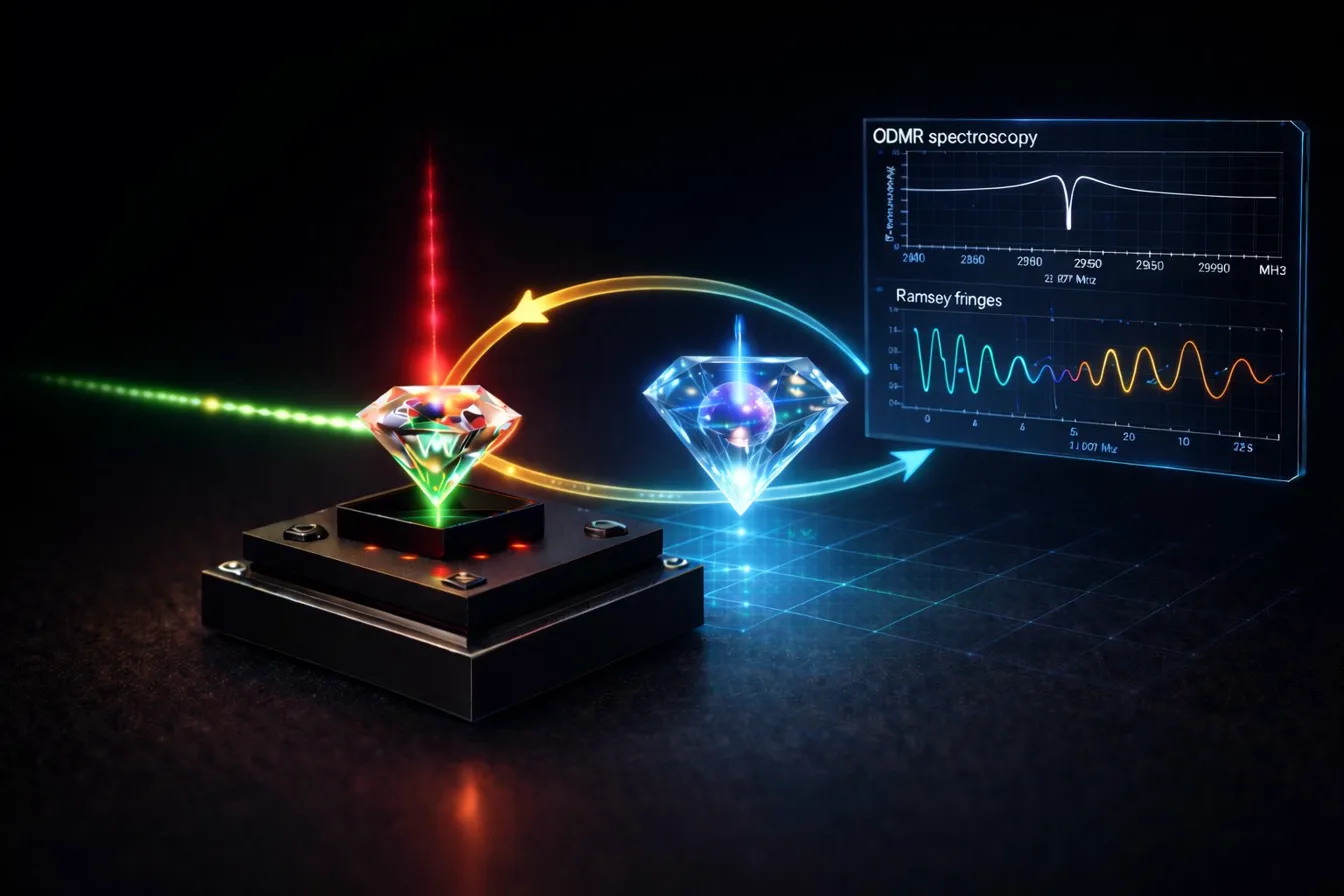
Digital Twins for Quantum Hardware

  • Time-resolved quantum imaging — Quantum imaging technique (Walsh imaging) for detecting electromagnetic fields with arbitrary spatiotemporal and vectorial dependencies, achieving 100 ns temporal resolution and 1 μm spatial resolution. Enables real-time visualization of dynamic magnetic sources—from neural activity mapping to detecting defects in next-generation microelectronics.
  • AI for controlling quantum hardware — Reinforcement learning and meta-learning techniques for adaptive quantum control, with theoretical scaling laws and derived bounds on when adaptive approaches outperform robust ones. Reduces calibration overhead from hours to minutes, enabling quantum devices that self-tune in the field.
  • Digital twin frameworks — GPU-accelerated simulations for realistic emulation of diamond-based quantum hardware in real-world environments, achieving 50× speedup on NVIDIA H100 GPUs via CUDA-Q. Compresses months of experimental trial-and-error into days of simulation, dramatically accelerating quantum sensor development.
  • Portable quantum magnetometers — Miniature magnetometers for GPS-denied navigation using NV diamond on piezoelectric photonic circuits, achieving ~0.12 nT sensing accuracy with vector sensitivity. Provides reliable navigation for defense, emergency response, and autonomous systems when GPS is jammed or unavailable.
  • Ferroelectric spin control — First-principles demonstration of voltage-controlled spin reorientation in magnetically-doped oxides, showing 90° polarization switching induces 112° spin rotation. Opens a path toward ultra-low-power magnetic memory and spintronic devices controlled by voltage rather than current.
  • SELFE method — First-principles framework for predicting magnetothermal properties (Curie/Néel temperatures) with 100× improvement in sample efficiency. Accelerates discovery of magnetic materials for electric vehicles, renewable energy, and next-generation electronics.

This work has far-reaching impact: from GPS-free navigation for defense and emergency response in GPS-denied environments, to magnetocardiography for early detection of cardiac disease, and beyond.

In essence, I develop the simulation and optimization stack that lets you build quantum hardware on GPUs before building it in the lab. From first-principles materials prediction to adaptive control algorithms, my work compresses the quantum R&D cycle across every layer of the system.
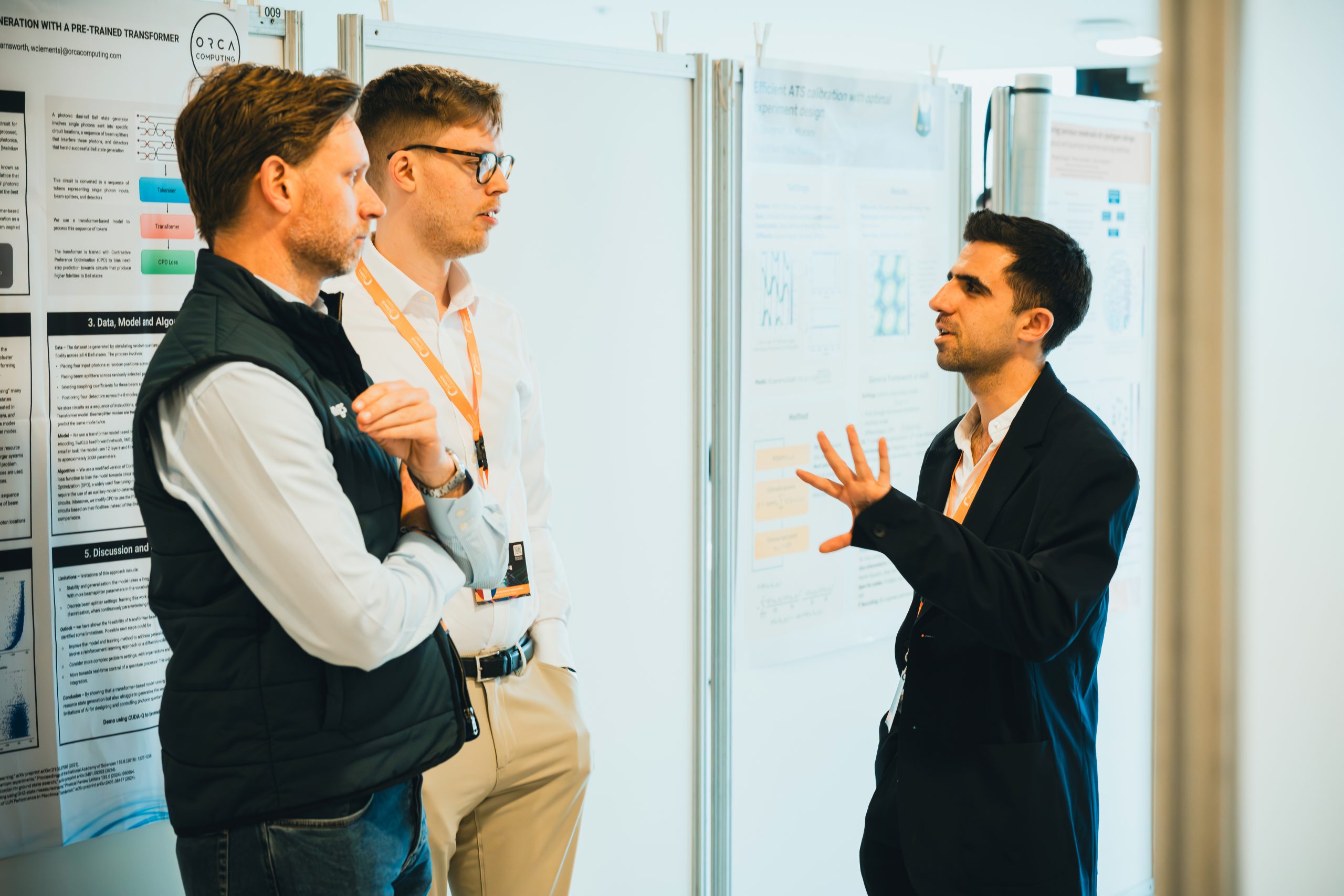
Novo Nordisk AI4Quantum Meeting
Novo Nordisk AI4Quantum Meeting in Copenhagen

I have been an invited speaker at various international venues:

  • NVIDIA GTC 2025 — Presented on GPU-accelerated quantum simulation (San Jose)
  • IEEE Quantum Week — Delivered invited talk on digital twins (Albuquerque)
  • The Economist 2024 — Participated in panel discussion on quantum sensing commercial applications (London)
  • The Economist 2025 — Participated in panel discussion on quantum magnetometers for navigation in GNSS denied environments (London)
  • U.S. Congress — Briefed legislators on quantum national security(Washington)
  • Quantum Australia 2026 — Upcoming invited talk (Adelaide)

My work has been featured in:

  • MITRE News — "MITRE Builds New Quantum Imaging Using NVIDIA CUDA-Q"
  • Business Wire — Walsh Imaging technology announcement
  • The Quantum Insider — Coverage of MITRE-NVIDIA quantum imaging collaboration
  • Inside Quantum Technology — Syndication of "A Quantum Sputnik Moment"
  • Springer Nature — "Science on the Hill: Planning for a Post Quantum Future"
  • Penn Engineering — "Meet Our Students" feature profile

I have briefed ambassadors, former heads of state, and cabinet officials on quantum technology and national security, including Australian Ambassador Kevin Rudd, former Liberian President Ellen Johnson Sirleaf, and former Swedish Prime Minister Carl Bildt. My writing on quantum policy, including "A Quantum Sputnik Moment", has been published in Just Security.

I received my undergraduate training in Materials Science and Engineering from Cornell University, where my senior honors thesis focused on quantum mechanical noise in next-generation transistors. I did my PhD studies in Electrical Engineering at the University of Pennsylvania where my research focused on quantum control of silicon-based quantum processors, where I was a Dean's Fellow and Perry World House Policy Graduate Associate.

Beyond the Lab

Outside of research, I'm a competitive distance runner—I placed 2nd overall at the 2019 San Francisco Half Marathon (1:20:23). I've traveled to 45+ countries across six continents, with Tanzania as my favorite destination. I'm also an advanced skier who favors challenging terrain at Jackson Hole and Zermatt, and a concert pianist.


Education

University of Pennsylvania

University of Pennsylvania

Ph.D. Studies in Electrical Engineering, 2020-2023

Dean's Fellow, Policy Graduate Fellow, Penn Track Club.

Focused on spin-based quantum computing in silicon and quantum control optimization. Recruited by MITRE and then led its Adaptive Quantum Sensing Program prior to dissertation.


Cornell University

Cornell University

Bachelors in Materials Science and Engineering (concentration in electronic/quantum technology materials) and minor in Computer Science, 2017-2020

Cornell Tradition Fellow, CURB Research Mentor, Cornell Materials Society, Cornell Piano Society, Cornell Track Club.

Honors thesis focused on quantum mechanical noise sources in next-generation, low-power transistors.


Awards

Perry World House

Perry World House Graduate Fellowship, 2021

Perry World House Profile

Selected to be among 26 from 200+ applicants at Penn to investigate the national security implications of quantum technologies.


Penn

The Dean's Fellowship, 2020

Dean's Fellowship

Selected among hundreds to receive $50,000/year for tuition and living expenses over 5 years of my doctoral studies.


LLNL

Computational Chemistry and Materials Science Summer Fellowship, 2021

CCMS Fellowship

Selected among hundreds based on proposed work for spin-based quantum sensors (declined).


Boeing

Cornell Engineering Learning Initiative Research Fellowship, 2017

ELI Fellowship

Awarded $1,850 through competitive proposal review process to develop solid-state electrolyte batteries. Funded by Boeing, work conducted at Cornell.


Cornell Tradition

The Cornell Tradition Fellowship, 2017

The Cornell Tradition

Awarded competitive $2,000 fellowship for my commitment to public service.


Caltech

Summer Undergraduate Research Fellowship (SURF), 2017

SURF Program

Proposal selected from competitive-review process to develop 3D microbatteries for heart transplants at Caltech.


Parkmerced

Robert L. Pender Memorial Scholarship, 2016

Parkmerced News Mention

Single awardee among 100+ applicants for a $1,000 award for my research on solid-state batteries.


Research Experience

MITRE

MITRE Corporation, 2023-Present

Principal Investigator leading the Adaptive Quantum Sensing Program, a multi-institutional initiative spanning MITRE, NVIDIA, and Quantum Brilliance. Developing AI-driven frameworks for quantum control. Invented GPU-accelerated digital twins for hardware and Walsh Imaging technology in partnership with NVIDIA. Advising senior government officials.


Penn Engineering

Quantum Hardware Lab, 2020-2023

Fabricated silicon-based quantum dot processors, developed optimal quantum control protocols with microwave pulse engineering, and developed a quantum random access memory to systematically increase qubit connectivity. As the first PhD student in the lab, spearheaded efforts in setting up the lab's infrastructure, mentored new masters and PhD students, and led projects in quantum pulse engineering for high-fidelity control.


QEL

Quantum Engineering Lab, 2020-2021

Worked with experimental and theoretical collaborators at Penn and Brown, I developed a qubit inverse-design algorithm based on Bayesian optimization. Wrote a section of an NSF annual report.


LBNL

Griffin Group, 2019-2020

Developed the theoretical groundwork for a new class of quantum bits: electric field controlled spins in ferroelectrics. Collaborated with experimental groups at Berkeley and Oxford to synthesize and physically realize electrostatic spin control. Primary contributor of a codebase to automate theoretical calculations on supercomputing facilities. Presented findings at several conference venues and prepared/submitted manuscripts. Learn more here.


Cornell Engineering

Jena-Xing Lab, 2017-2020

Contributed to the development of the first III-V epitaxial semiconductor-superconductor tunnel junction. Built a low-frequency noise characterization setup from scratch to identify sources of quantum mechanical noise in semiconductor heterostructures for honors thesis. Spearheaded first principles modeling efforts within the group. Mentored masters students on material design problems. Learn more here.


LBNL

Neaton Group, 2018

Awarded the competitive SULI internship to design valleytronic devices under Dr. Jeffrey Neaton at The Molecular Foundry . Utilized advanced electronic structure theory to design a new class of beyond-Moore's law device materials. Presented work at several conference venues. Learn more here.


Cornell Engineering

Robinson Lab, 2017-2018

My proposal was awarded to integrate a solid state electrolyte (LiPON) into a nanoparticle cathode system. Utilized statistical mechanical models, plasma and colloidal synthesis, and electrochemical characterization to design highly energy and power dense solid state batteries. Learn more here.


Caltech

Greer Lab, 2017

I was awarded a SURF fellowship based on my proposal to develop 3D nanoarchitected batteries. Used two-photon lithography to fabricate 3D polymer nanoscaffolds and deposited Li anodes with LiI solid-state electrolytes to facilitate high-energy dense storage. Learn more here.


SFSU

Adelstein Group, 2015-2017

Using electronic structure methods and molecular dynamics, I designed a new class of Lithium thiophosphate solid-state electrolytes for high energy storage batteries. I led my own project in collaboration with the Quantum Simulations Group at Lawrence Livermore National Lab to predict lithium diffusion pathways in these materials from quantum mechanics. I later presented my work at several national conferences. Learn more here.


Industry Experience

Arcturus

Arcturus, 2024-Present

Arcturus

Partner at a deeptech due diligence and advisory firm helping investors navigate the complexities of frontier technologies. Our global team of experts ensures that deeptech investments are grounded in rigorous scientific analysis, reducing risk and uncovering hidden opportunities. We serve venture capital firms and corporate venture arms, evaluating investments across quantum computing, AI, semiconductors, and advanced materials. Offices in Palo Alto and Boston.


Kepler

Kepler Computing, 2021

Kepler Page

Spearheaded the device design efforts at Kepler Computing (low-power computing device startup in Berkeley, CA). Established an automated testing framework for characterizing the polarization and electronic properties of ferroelectric memory devices. Developed thermodynamic, electronic structure, and device modeling frameworks to aid the design and measurement of ferroelectric films and memories. Key efforts in the company's device engineering currently rely on the frameworks that I have developed. Worked closely with faculty at UC Berkeley, including Dr. Ramamoorthy Ramesh.


PsiQuantum

PsiQuantum, 2019

PsiQuantum Page

Developed a framework for the optimal design of superconducting single-photon detectors, necessary for readout of photonic quantum computers. I combined experimental results, theoretical models, and Bayesian optimization to design detectors with maximal efficiency. The designs I created are currently being used by the company, being fabricated in large-scale tapeouts. Worked closely with Dr. Faraz Najafi and Dr. Jeremy O'Brien.


Teaching Experience

Inspirit AI

  • Machine Learning Innovator Program Instructor (college level), Winter 2021
  • Deep Learning Course Instructor (high school level), Summer 2021
  • Machine Learning Course Instructor (high school level), Spring 2021

University of Pennsylvania

  • Head Teaching Assistant for Fundamentals of Linear Algebra and Optimization (CIS 515), Spring 2022
  • Head Teaching Assistant for Fundamentals of Linear Algebra and Optimization (CIS 515), Spring 2021
  • Teaching Assistant for Fundamentals of Linear Algebra and Optimization (CIS 515), Fall 2020

Cornell University

  • Teaching Assistant for Principles of Large-Scale Machine Learning (CS 4787), Spring 2020

San Francisco State University

  • Math, Science, and Engineering Tutor at Campus Academic Resource Program, Fall 2015 - Spring 2017

Outreach

Save the Frontline

#savethefrontline co-founder, 2020

#savethefrontline

Co-founded a nonprofit with a team of Cornell alumni at the start of the COVID-19 pandemic to establish a distribution framework of PPE to healthcare workers and other first responders in New York City. Raised over $300,000 for PPE and distribution costs and delivered over 80,000 supplies to those in need. Established partnerships with local businesses in NYC to expedite distribution. Efforts were featured in several media outlets.


CURB

CURB Peer Mentor, 2018-2019

CURB Mentor Program Page

Volunteered as a peer mentor for four semesters through CURB at Cornell. Efforts focused on introducing freshmen and sophomores to undergraduate research, identifying research interests, and establishing connections with Cornell faculty. 100% success rate in matching students with their top 3 research groups.


  • © Nima Leclerc 2025. All rights reserved.