 Nima Leclerc
Journey · The story
From a chemistry set to a quantum computer
How I think: control a reaction, then a material, then a quantum computer, and why the path there was never a straight line.
- Control a reactionKnobs: ratios, temperature, current
- Control a materialKnobs: which atoms, where they sit
- Control a quantum computerKnobs: fields and pulses
A lab in my room
When I was eight, I built a chemistry lab at home. It began with a Chem C3000 kit and grew as I ordered chemicals and glassware by mail, until a shelf in my room held jars of elements, each labeled by its symbol.
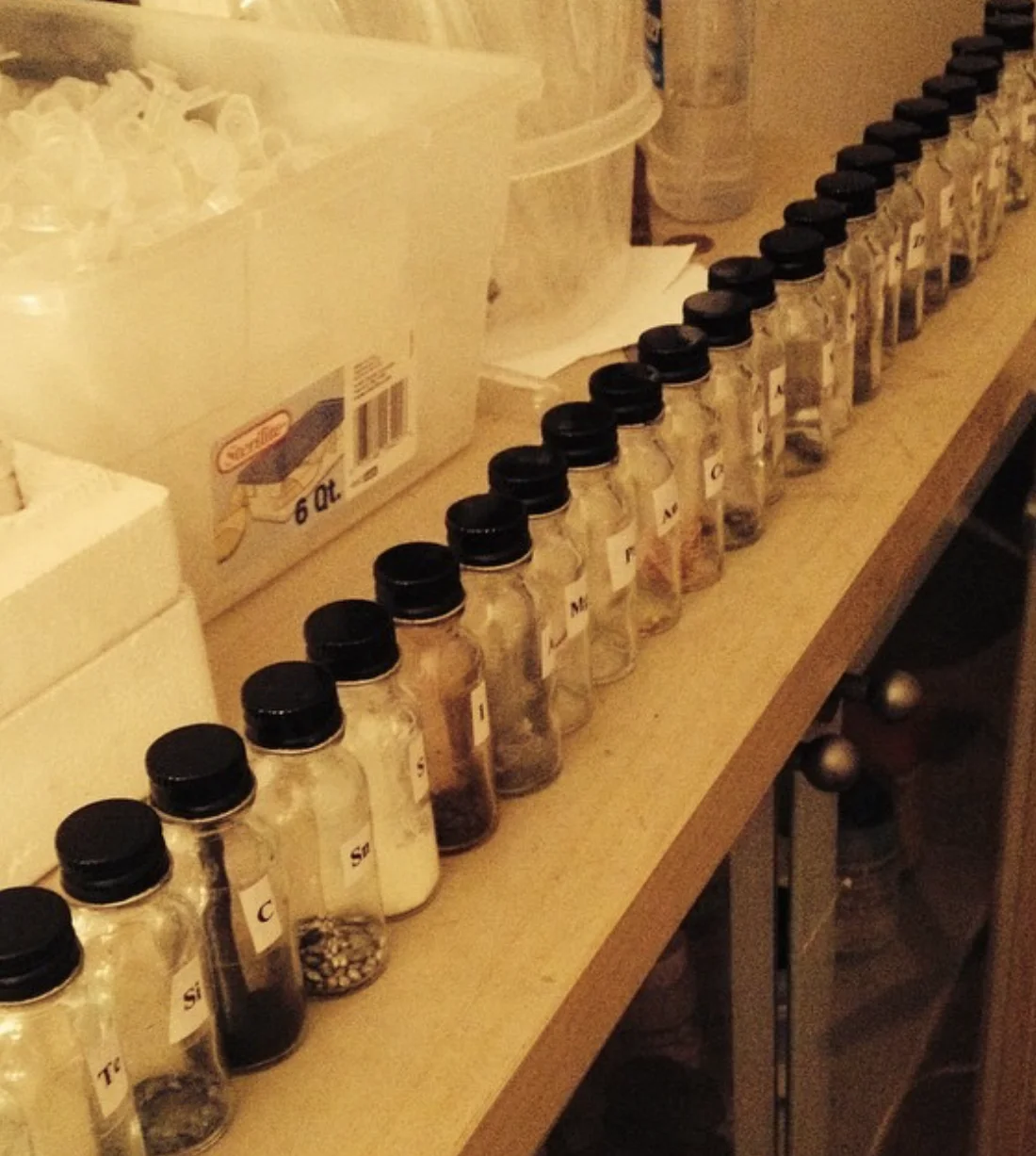
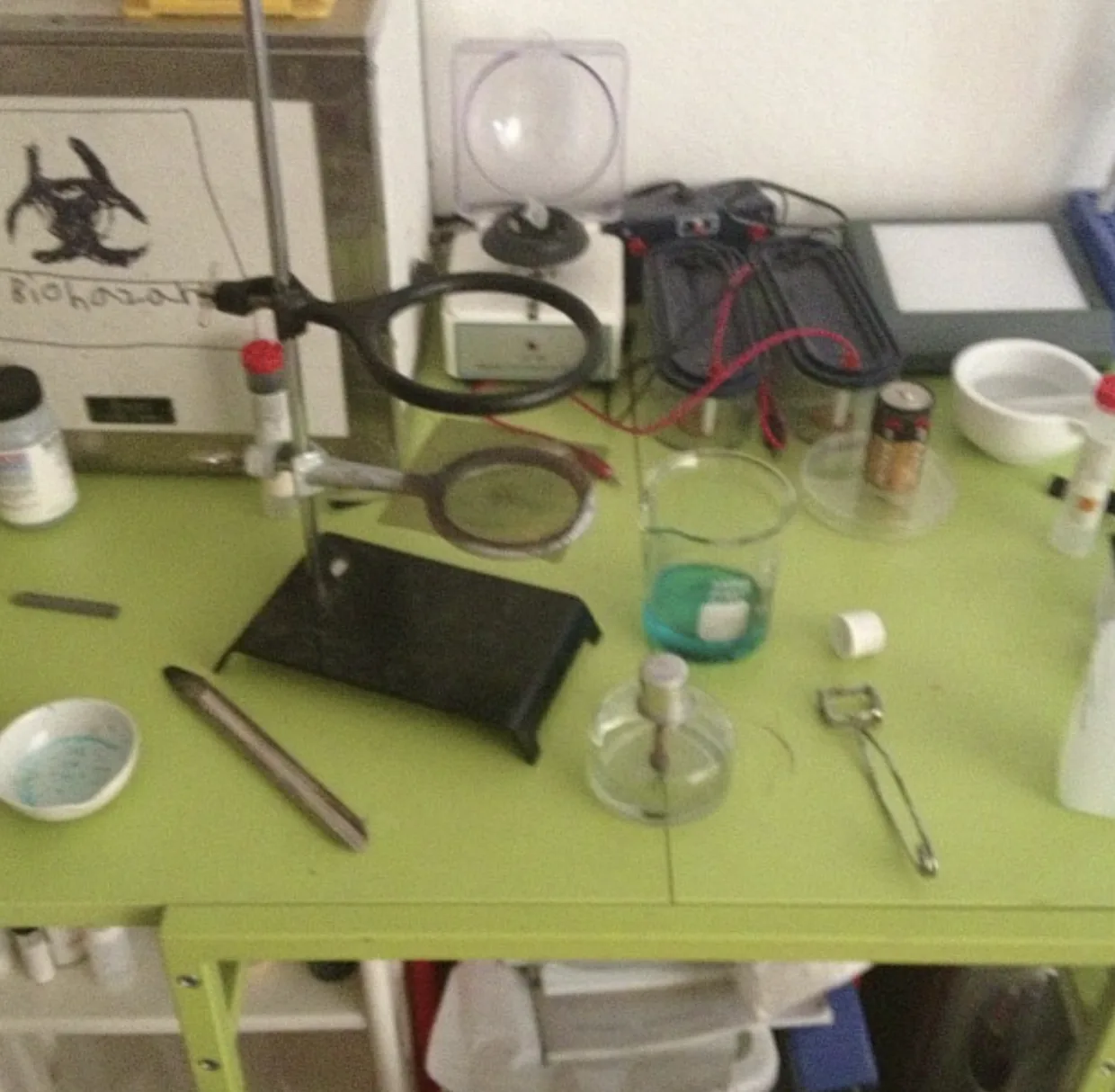
What surprised me was not the colors or the smoke. It was that I could make things from the ground up. Start with the right reactants, run the right reaction, and a pure element would turn up in the jar. Many of the elements on that shelf were ones I synthesized myself, about thirty in total. In the same spot I later built a small biotech lab too, with a gel electrophoresis setup and an incubator.
Looking back, the real lesson was that every reaction came with a short equation, and the equation told me which things I was free to change. This page is about that habit, and how it followed me, by a winding route, from a bedroom to a quantum computer.
1. Controlling a reaction
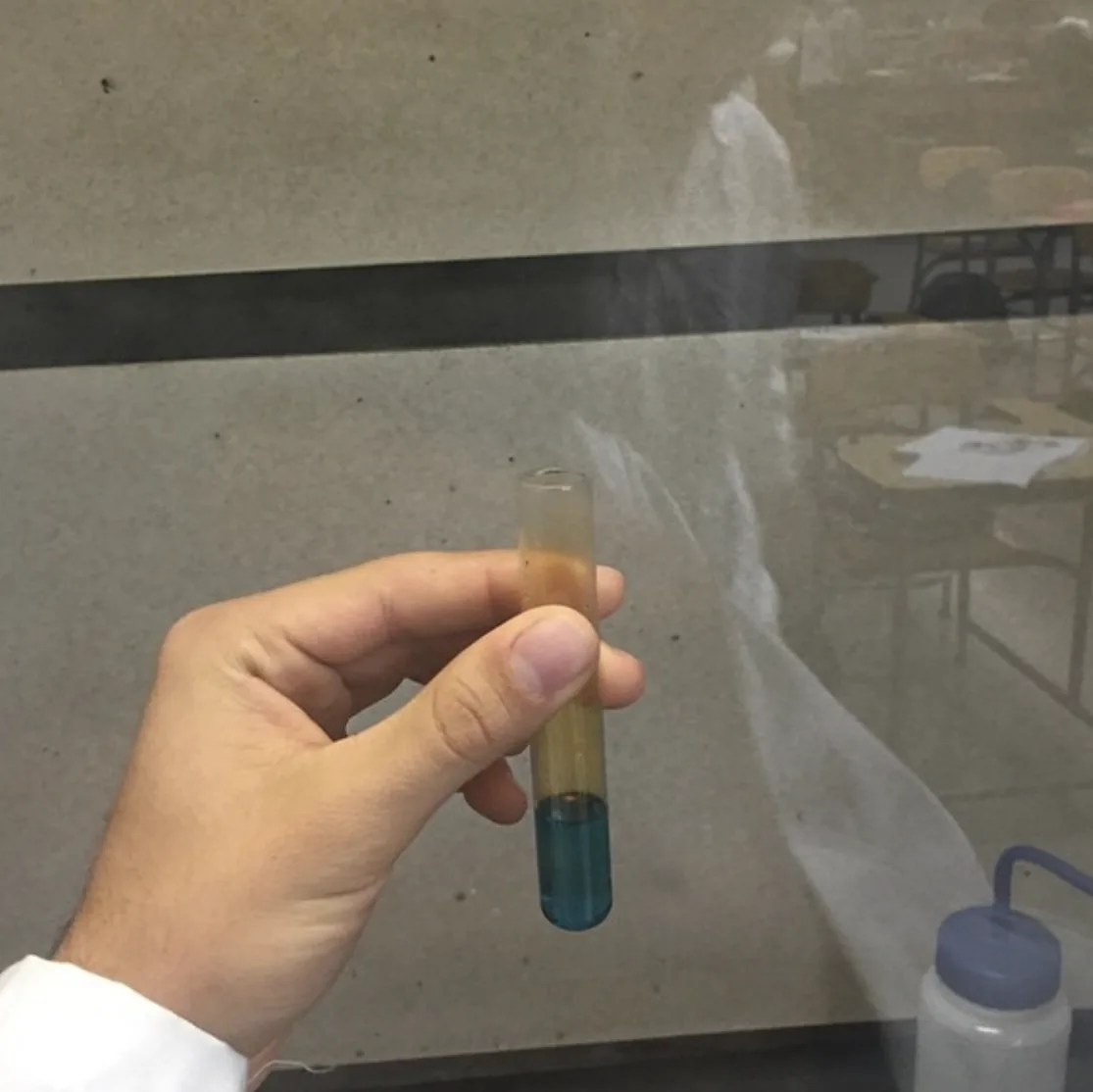
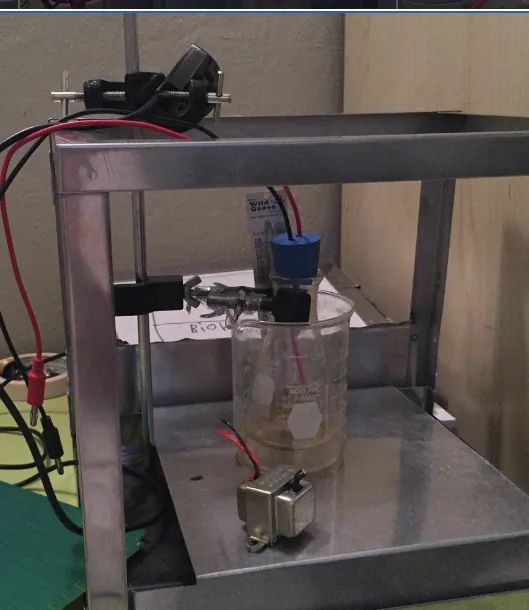
The reaction I remember best is copper and nitric acid. The copper dissolves, the liquid turns a deep blue (copper nitrate), and a brown gas, nitrogen dioxide, bubbles off. (That gas is toxic, so this one belongs in a fume hood or under adult supervision.) On paper it is one line:
I read that line as a set of knobs. The first is the ratio. The coefficients say each copper atom needs four nitric acid molecules, so if I weigh out the copper (mass m, molar mass M) I know exactly how much acid it takes:
Use less acid and it runs out first. Use more and the extra is wasted. The second knob is temperature and concentration, which set how fast the reaction goes. A reaction has to climb an energy barrier, and heat gives the molecules more energy to do it, so the rate changes exponentially with temperature:
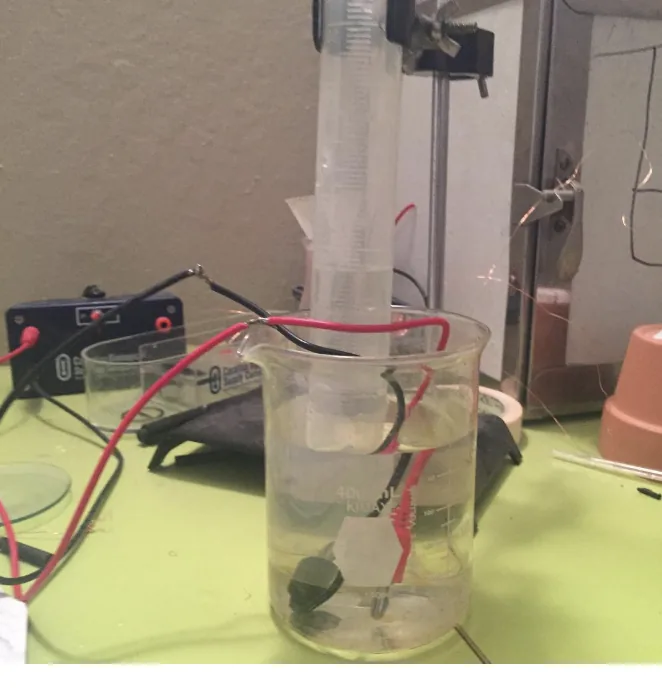
Electrolysis gave me a third knob, and it is the one I think about most now. Pass a current through a solution and the amount of material you make is set by a single number, the charge you pushed through, so an electrical signal becomes a chemical dial:
The biotech side of my bench used the same trick. In gel electrophoresis, an electric field pulls charged DNA through a gel, and the field sets how fast it moves, , where μ is the mobility. Once again, a signal I control sets the outcome.
2. Controlling a material
Chemistry showed me how to make a compound. Materials science asks the bigger question: given a material, why does it behave the way it does, and which atoms should I move to make it better? That is why I studied Materials Science and Engineering, and it is what I worked on first at San Francisco State.
The problem was batteries. Most lithium-ion batteries use a liquid electrolyte that can catch fire. A solid electrolyte could be safer and more compact, but only if lithium ions move through it nearly as fast as through a liquid. Two leading candidates are Li3PS4 (LPS) and Li10GeP2S12 (LGPS). Both are built from similar pieces, yet in the measurements I worked from, crystalline LGPS conducts lithium roughly 200 times better than LPS (about 1.2 × 10⁻² versus 5.6 × 10⁻⁵ siemens per centimeter at 300 K).
We could not build and test every variation, so we simulated them. The equation behind it is the one that governs electrons around atoms. Put the atoms down, solve for the electrons, and you get the force on every atom. Then let time run:
The first line is density functional theory (DFT), a way to solve the quantum mechanics of the electrons. The second is Newton's law, moving the atoms under those forces. Together they turn a supercomputer into a movie of atoms.
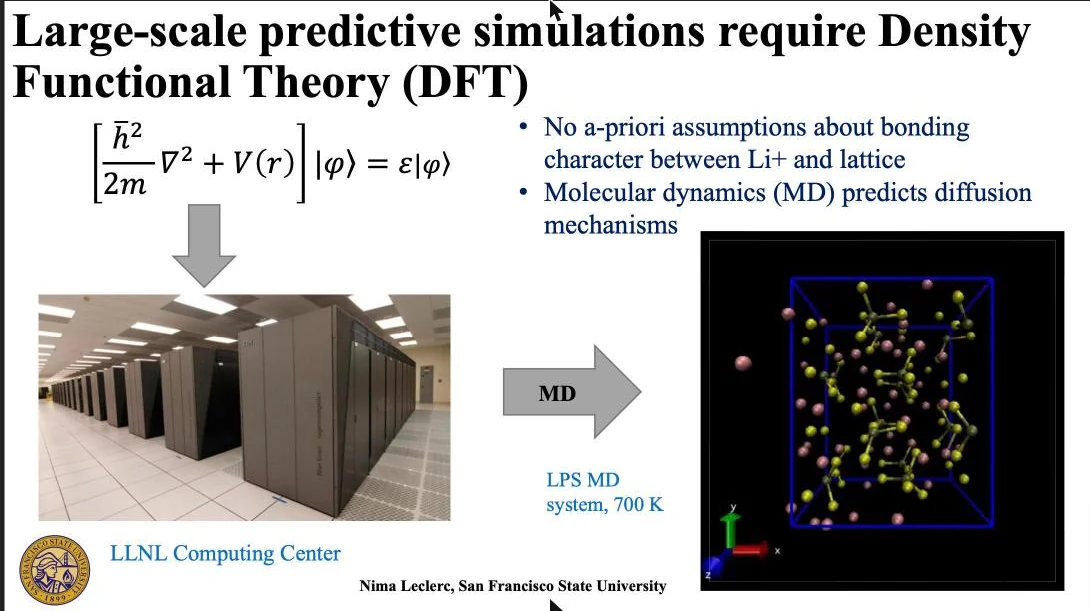
To read the movie, I tracked how far the lithium ions wander over time. For random hopping, the mean squared distance grows in a straight line, and the slope is the diffusion coefficient D. Then D has the same shape as the reaction rate from my chemistry lab, because lithium also has to hop over an energy barrier, and conductivity follows from D (up to correlation effects):
I like that the math is almost the same one I used with copper and nitric acid, just at a much smaller scale. Here the knobs were no longer ratios and temperature but which atoms are present and where they sit.
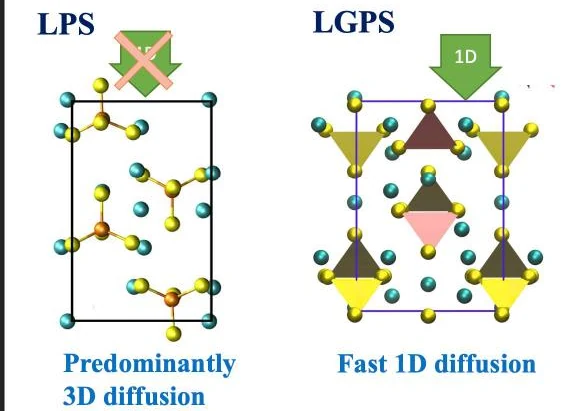
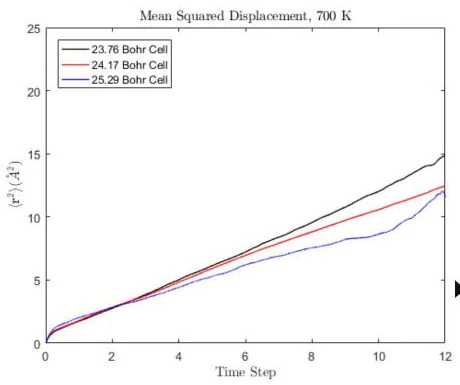
The surprise in this project was that the barriers were similar in the two materials, so barrier height alone could not explain the gap in conductivity. We were asking whether something subtler, such as lithium ions moving in a coordinated way, was doing the work. I came away with something that stuck: if you can compute why a material works, you can choose what to build instead of guessing. I presented the work at the American Chemical Society and Electrochemical Society meetings.
- DFT Molecular Dynamics Simulations of Li+, Electrochemical Society, Honolulu, 2016 (poster). Abstract
- Understanding Li+ diffusion behavior in amorphous and crystalline Li3PS4 solid electrolytes, via ab-initio simulations, American Chemical Society, San Francisco, 2017 (talk). Slides
- Analysis of the role of the electronic structure on lithium diffusion in Li10GeP2S12 and Li3PS4 solid electrolytes, American Chemical Society, San Francisco, 2017 (poster). Citation
Where the method runs out
The catch is that the electrons in a material are a quantum system, and the space they live in grows exponentially. For N two-level quantum degrees of freedom, the state needs 2N numbers:
DFT gets around this by approximating how electrons push on each other, and for many materials that is good enough. For the hardest and most interesting ones, such as strongly correlated materials, the approximation is exactly where the answers stop being reliable. Every simulation I ran was also expensive for a small slice of crystal. I wanted to turn the knobs on the true quantum mechanics, not an approximation of it. Richard Feynman's old suggestion was to simulate nature with a machine that follows the same rules. A quantum computer is that machine, and that is what pulled me toward quantum computing.
3. Controlling a quantum computer
A quantum computer is built from quantum bits, and the equation that governs one is the same family as the one governing the electrons in my battery simulations. A qubit's state evolves under the Schrödinger equation, and the Hamiltonian H is where the knobs live:
For a spin qubit in a magnetic field, driven by an oscillating field, the Hamiltonian has two parts. A steady one sets the qubit's natural frequency, and a driven one is the control. Tuned to resonance (in the rotating-wave approximation), the drive makes the qubit flip back and forth at a rate I choose:
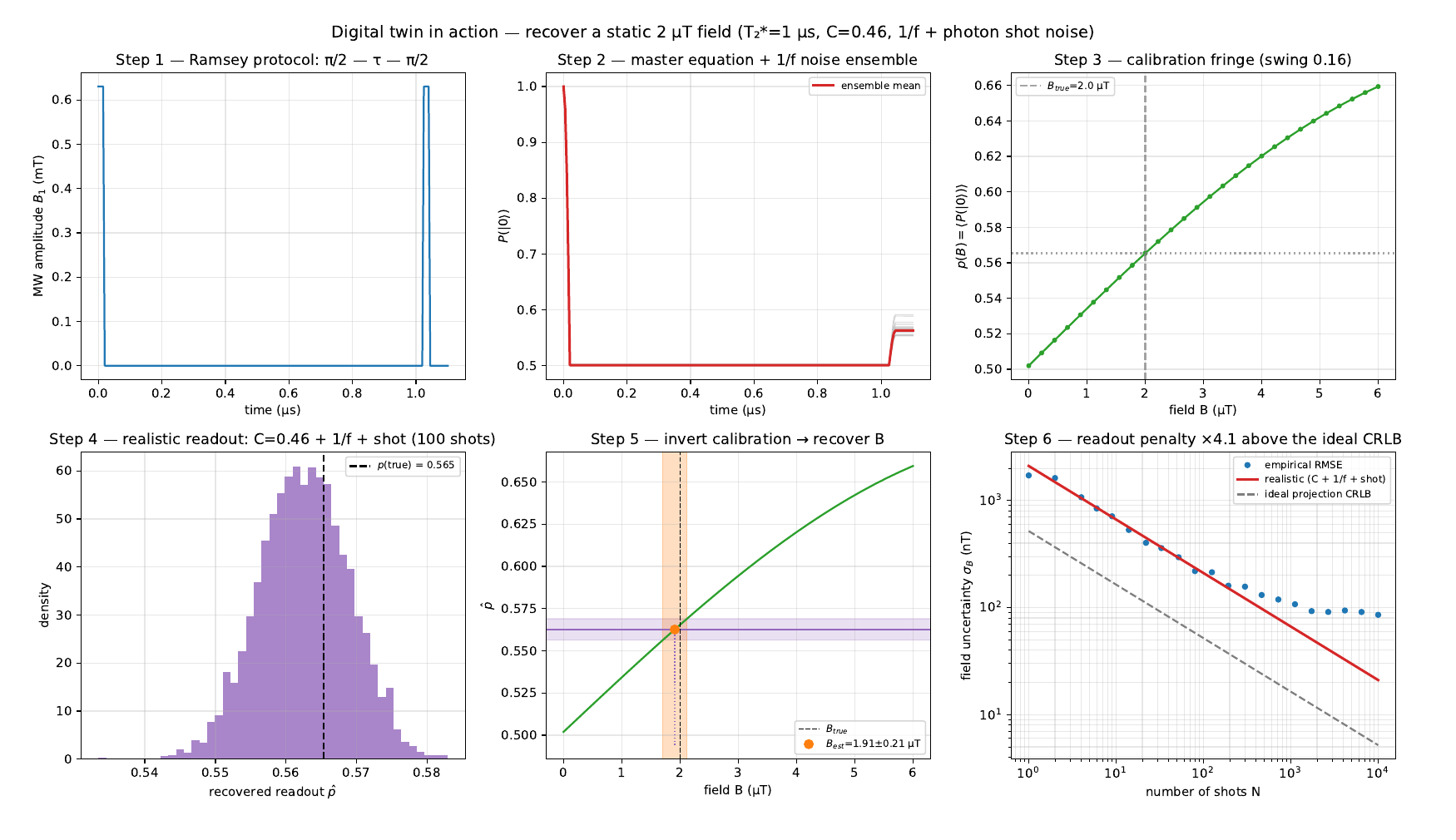
Amplitude, frequency, phase and duration are the new knobs. They are the same kind of dial as the current in my electrolysis rig: a signal I control sets the outcome. Real devices are noisy and drift, so I also need to model what the environment does to the qubit. That is the master equation I use in my digital twin work:
A digital twin is that equation tuned to a specific device, so it can predict what the device will do before I run it. It is the same instinct as the copper and nitric acid line on a page: predict, then test. At MITRE I did this for quantum sensors, and at Diraq I do it for silicon spin-qubit processors.
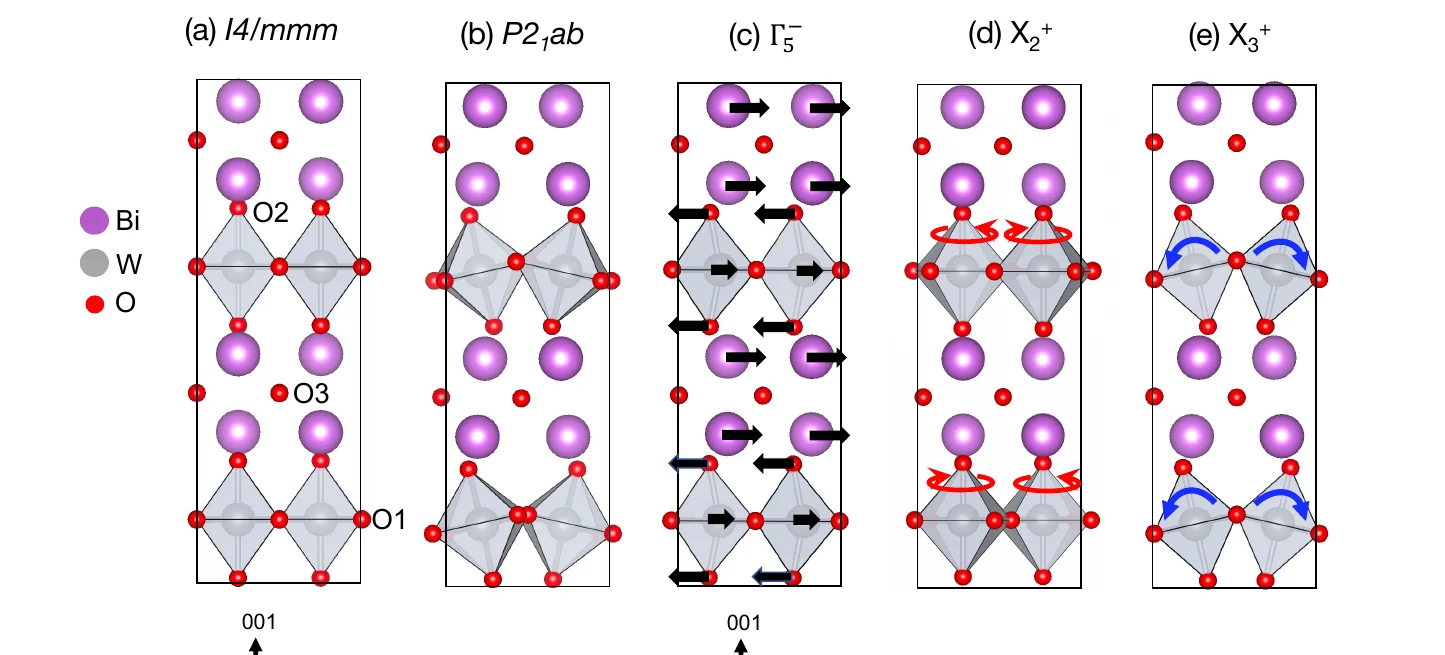
My PhD-era work also closed a small loop between these two worlds. In a paper in Physical Review B, we used DFT, the same family of method as in my SFSU days, to study a crystal where an electric field can rotate the direction of an embedded spin. It is a material studied for how it can control a spin, which is where my materials work and my quantum work meet. There is a plain-language explainer of that paper.
Why I want to build one
These three steps are one idea at three scales. Controlling a reaction meant controlling ratios and temperature. Controlling a material meant controlling which atoms sit where. Controlling a quantum computer means controlling the quantum state itself. And the loop closes, because a quantum computer lets me solve the electron equation from the second step directly, instead of approximating it.
That is what I actually want: not qubits for their own sake, but a machine that can design materials from the atoms up. A better battery electrolyte is one example. Catalysts, semiconductors, superconductors and medicines are others, so the next generation of materials could be designed on purpose for every industry instead of found by trial and error.
None of this was a straight line. It ran from a kit in my bedroom to a battery lab, to a transistor-noise thesis at Cornell, to silicon qubits at Penn, to quantum sensors at MITRE and now to spin-qubit processors at Diraq. But looking back, each stop was the same habit, applied to a harder system. Quantum computers that can design materials do not exist yet, and the road is long. This is the problem I want to spend my career on.
The rest of my work is on the home page, with plain-language write-ups of my papers under Explained.