 Nima Leclerc
Explained · 03 · Conference paper · CLEO 2025
A chip-sized compass for navigating without GPS
A proposal for a tiny diamond magnetometer that reads the Earth’s magnetic fingerprint from a drone.
The problem
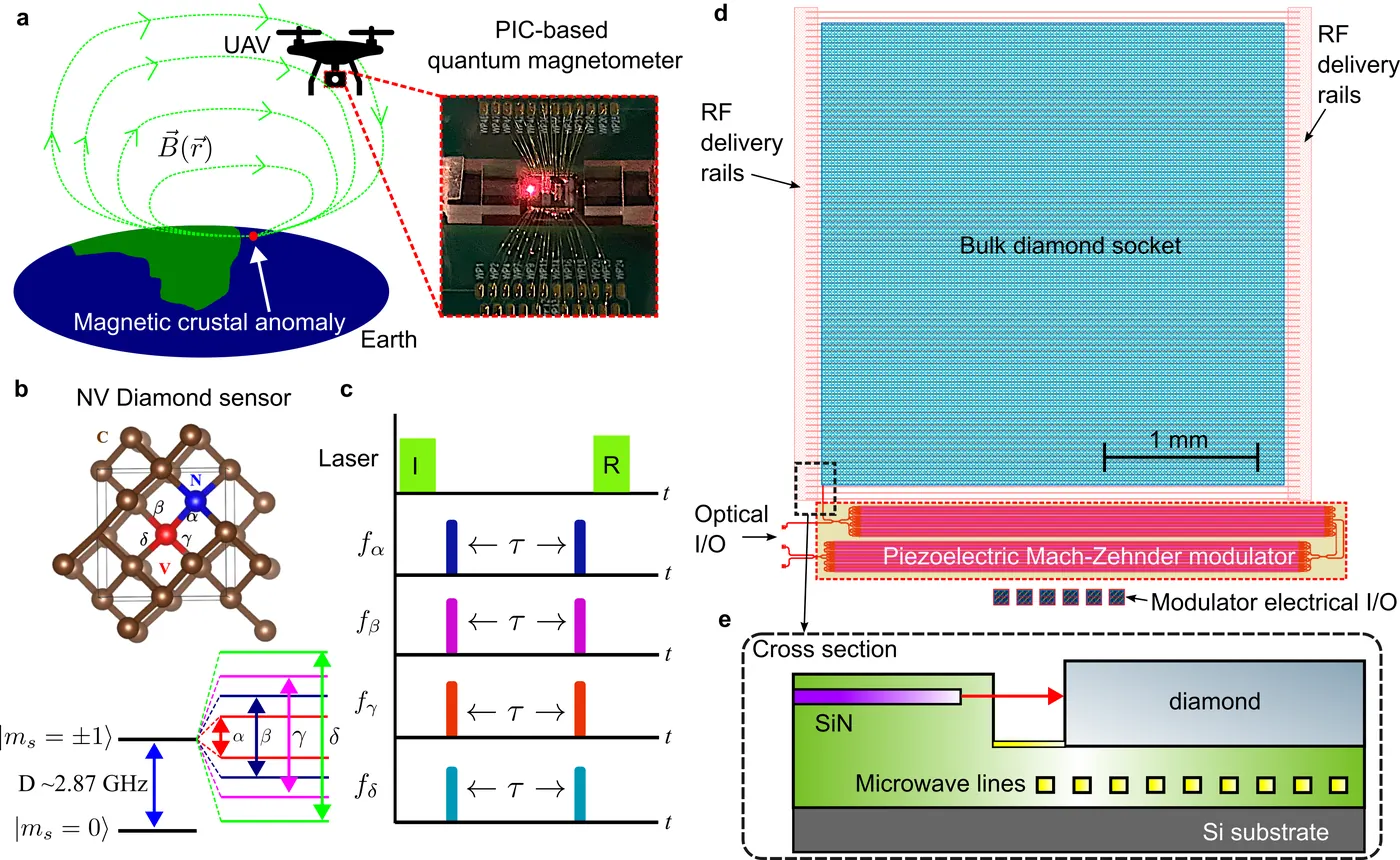
GPS is easy to jam and easy to spoof. One backup is magnetic navigation: the Earth’s crust is magnetized unevenly, which paints a map of tiny field variations that is fixed to the ground and cannot be jammed. If a vehicle can measure the local field precisely enough, it can compare it to a stored map and work out where it is.
Today’s magnetic-navigation sensors mostly measure only the strength of the field, and they are easily corrupted by the metal and electronics on the vehicle that carries them. Small drones, with strict limits on size, weight and power, are especially hard to serve.
The idea
We propose a magnetometer built from nitrogen-vacancy (NV) centers in diamond. An NV center is an atom-sized defect, a nitrogen next to an empty site, whose electron spin glows differently depending on the magnetic field. Because the defects sit along four fixed directions in the crystal, a single diamond can report the field’s direction as well as its size, which is the vector information that is harder to corrupt.
The new part is the packaging. Instead of a bench full of lasers and microwave hardware, we put the control on a photonic chip: a piezoelectric optical modulator switches laser light on and off quickly, a silicon-nitride waveguide guides it into the diamond, and microwave lines under the diamond deliver the control pulses.
Will it be sensitive enough?
We checked with simulations. Finite-element modeling shows the microwave lines can drive the whole diamond uniformly, and optical modeling shows light trapped inside the diamond illuminates its full volume. A model of the NV energy levels, with realistic decay rates and noise, shows how decoherence and laser noise degrade the ideal signal.
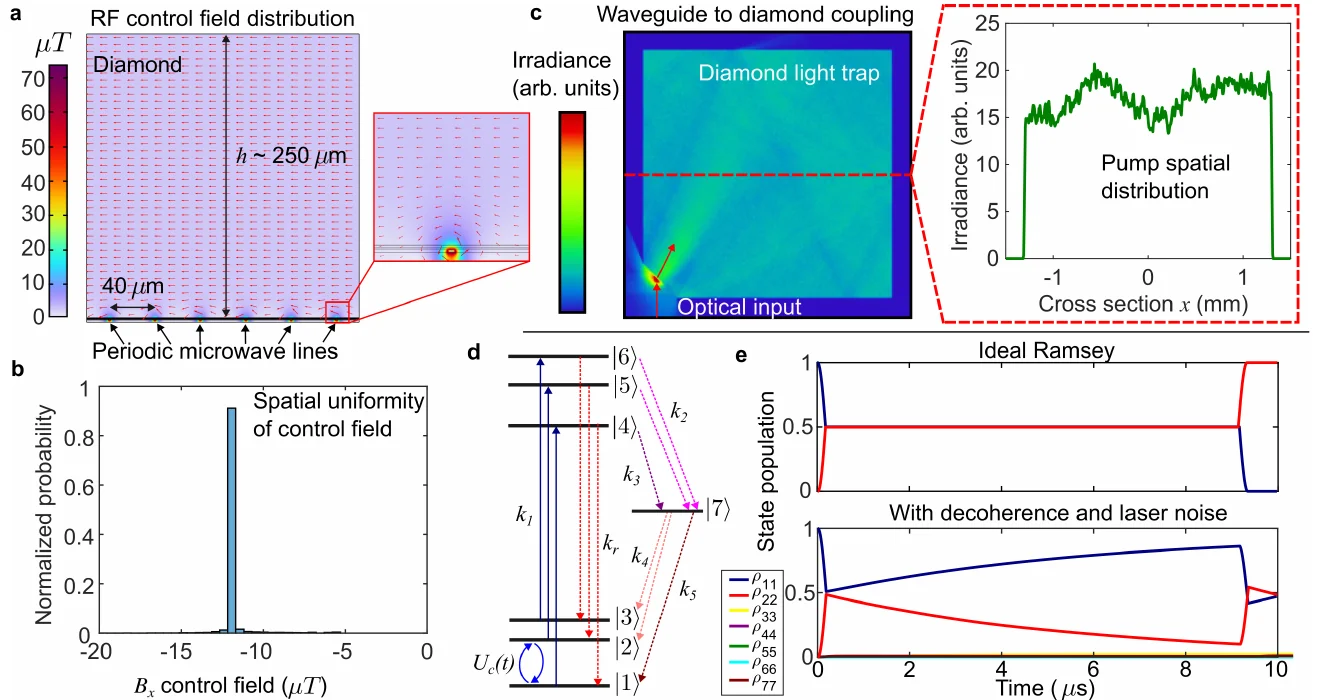
Using standard formulas and conservative assumptions (a 2.6 × 2.6 × 0.25 mm diamond with 0.1 ppm NV density, 10 µs coherence), we estimate a best sensitivity of about 390 femtotesla per root hertz and a short-term error of about 0.12 nanotesla.
The limits
This is a design and simulation study, not a flight-tested instrument. The numbers are estimates, long-term absolute accuracy has not been addressed, and better pulse sequences are left to future work. The point of the paper is to show that an integrated, vector-capable sensor small enough for a drone is a reasonable thing to build.